Xero Integration and MTD for Sole Trader Customers
Making Tax Digital for Income Tax applies to sole traders and landlords with qualifying income above £50,000 from 6 April 2026, falling to £30,000 from April 2027 and £20,000 from April 2028 (HMRC, 2026). Many resellers have sole traders among their business customers, and those customers now need to keep digital records and send quarterly updates through compatible software.
Two separate questions follow. The first is how your own books stay accurate, which is where SAFE’s Xero integration helps. The second is what your sole-trader customers need from the invoices you send them. The integration does not reach into a customer’s accounting software, so it is worth being clear about where one ends and the other begins.
Key Takeaways
- MTD for Income Tax started on 6 April 2026 for sole traders and landlords with qualifying income above £50,000; the threshold falls to £30,000 in 2027 and £20,000 in 2028
- Limited companies are outside MTD for Income Tax; most resellers are affected through MTD for VAT and through their sole-trader customers
- SAFE’s Xero integration transfers customers, invoices and payments into the reseller’s own Xero organisation
- It does not send invoices into customers’ accounting software; customers record supplier invoices with their own tools
- Clear, consistent invoices with correct VAT make that recording easier, whichever software the customer uses
Key terms in this article
What is Making Tax Digital for Income Tax?
Making Tax Digital for Income Tax (MTD for ITSA) is HMRC’s replacement for the annual-only Self Assessment process for sole traders and landlords in scope. They must keep digital records, send quarterly updates through compatible software, and complete a year-end return.
What is qualifying income?
Qualifying income is gross income from self-employment and property combined, before expenses. HMRC uses the Self Assessment return for an earlier tax year to decide whether someone is in scope: the 2024 to 2025 return set the April 2026 intake.
Your Own Tax Position
Most resellers trade as limited companies, which pay Corporation Tax and are outside MTD for Income Tax. A VAT-registered reseller has been under MTD for VAT since it applied to all VAT-registered businesses in April 2022. For those resellers, the change in 2026 is on the customer side rather than in their own filing.
A reseller trading as a sole trader or partnership is different. A sole trader’s own billing income counts towards the qualifying income threshold, and HMRC has said partnerships will follow later.
What the Xero Integration Does
SAFE’s Xero integration works on your own books. After you authorise the connection, you run transfer tasks that send data from SAFE to your Xero organisation:
- Customers become Xero contacts. A contact that already exists in Xero under a slightly different name may be duplicated, so check new contacts after each run.
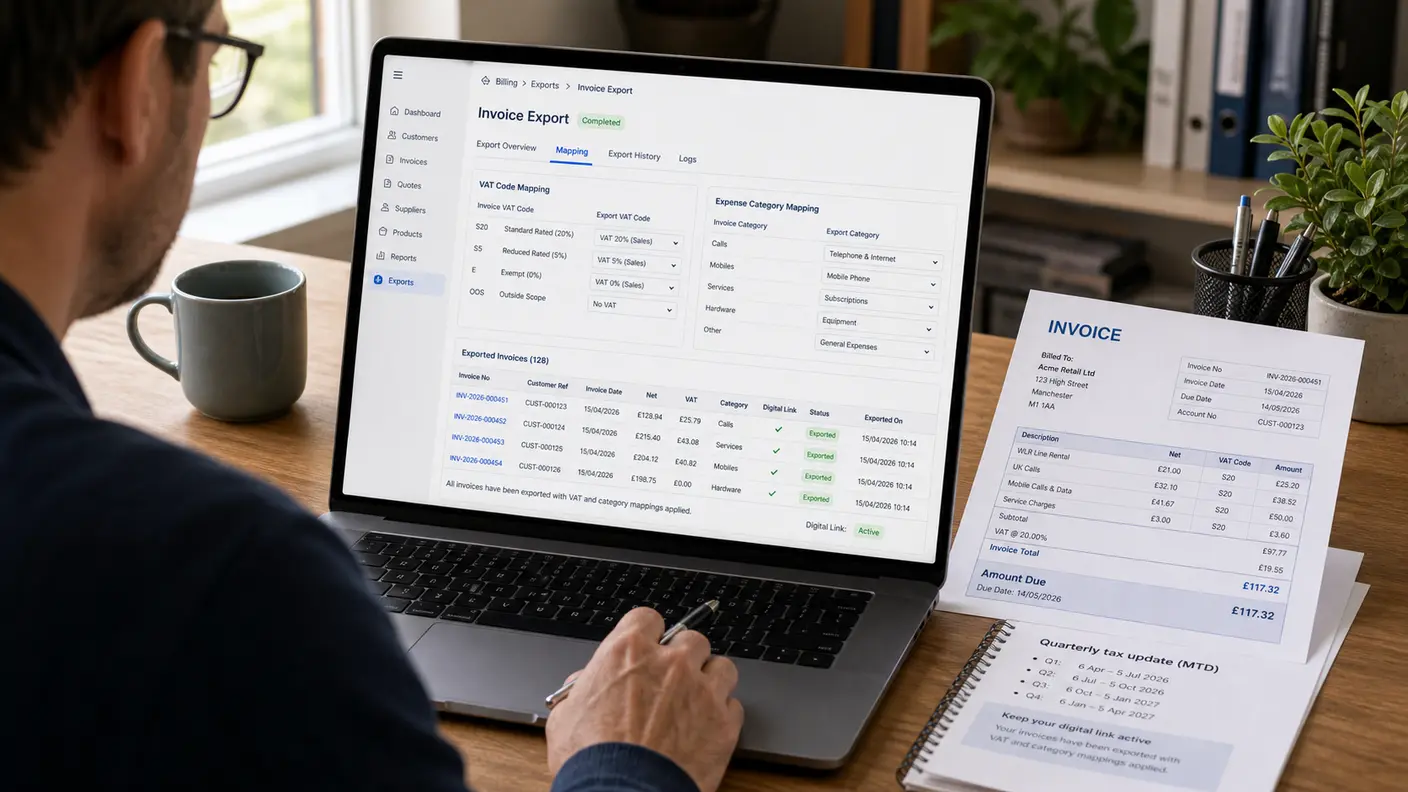
- Invoices are created in Xero with their line items, VAT treatment, due dates and the revenue accounts you have mapped.
- Payments collected through SAFE, whether by Direct Debit, card or manual entry, mark the matching Xero invoices as paid.
New payments recorded in Xero, such as those found through bank feeds, can also be brought back into SAFE. Most resellers run the tasks once per billing cycle, after the billing run and each collection run. The Xero integration overview covers the setup, and the documentation has the detail.
The integration is included on Enterprise and available as an add-on on Premium. It is not available on Startup or Standard.
What It Does Not Do
The integration connects SAFE to the reseller’s Xero organisation only. It does not create bills in a customer’s Xero, QuickBooks, FreeAgent or Sage account, and it plays no part in a customer’s MTD submissions. Avoid describing it to customers as something that feeds their accounts.
Your sole-trader customers record your invoice in their own software, in whatever way that software supports: entering it by hand, forwarding the PDF to a capture service, or using a bank feed match. HMRC’s rules allow records to be entered manually into compatible software; the digital-link requirements apply to how the data then moves between software products on its way to HMRC.
What Your Invoices Can Do for Sole-Trader Customers
What you control is the invoice itself. A sole trader recording dozens of supplier invoices a quarter benefits from invoices that are consistent from month to month:
- the same supplier name, address and VAT number on every invoice
- a clear invoice number and invoice date
- VAT shown correctly against each line, with any zero-rated or exempt items identified
- line descriptions that make the service obvious, such as line rental, calls or hosted seats
- access to past invoices through the customer portal, so a missing month can be downloaded rather than requested
SAFE produces invoices with these details as part of the normal billing run. Review your invoice template and service descriptions so that each charge is recognisable to a customer who did not set up the account.
Telling Customers About It
Some sole traders will ask whether your invoices “work with MTD”. The accurate answer is that MTD obligations sit with them and their accounting software, and that your invoices provide the details they need to record each one. Pointing them to the portal for past invoices answers most follow-up requests.
The MTD for ITSA post on safeonlinebilling.com covers the wider changes for resellers and their customers.
Where to Start
If you already use Xero, check that your revenue account and tax rate mappings match your current service catalogue before the next transfer run. To see how the transfer tasks fit around your own billing and collection cycle, arrange a demonstration.
Dr Paul Barrass
Founder & Technical Director, Safe Online Billing
Paul founded Safe Online Billing in 2005 and has built telecoms billing software for UK resellers for over 20 years. About the team →