
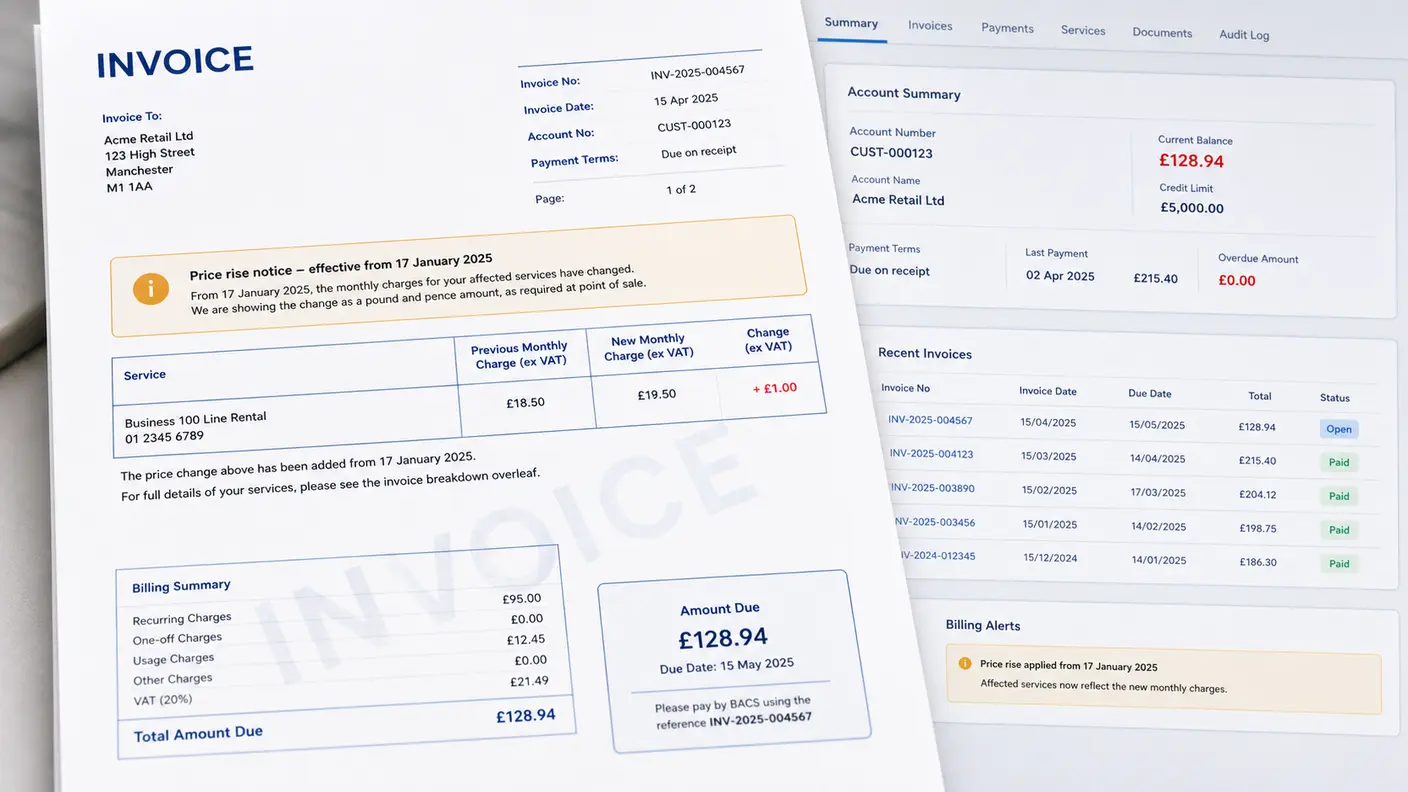
Ofcom Pounds-and-Pence Rules: What Resellers Must Change
Since 17 January 2025, every UK residential telecoms provider has had to express in-contract price rises as a specific pounds-and-pence amount, given to the customer at the point of sale. The “CPI plus 3.9%” wording the industry used for years is no longer allowed on new residential contracts. The rule is Ofcom General Condition C1.18, and it changes what resellers write in their sales materials, contracts and price-rise letters.
This post covers the rule, what to put in your contracts, and the small bit of SAFE Billing Platform work that comes after.
Key Takeaways
- Ofcom General Condition C1.18 took effect on 17 January 2025 (Ofcom inflation-linked price rises guidance, 2025)
- In-contract price rises on residential telecoms must be stated in pounds and pence at point of sale
- CPI-linked or RPI-linked wording is no longer permitted for new residential contracts
- Business contracts are not directly covered but the same wording habit is good practice
- The rule applies to pre-contract sales materials and contract terms, not just the billing run
- SAFE applies the tariff change cleanly when it falls due, and includes Ofcom-classification and correspondence-generation tools to help you produce per-customer price-rise letters from your own wording
Key terms in this article
What is Ofcom General Condition C1.18?
Ofcom General Condition C1.18 is the rule introduced in January 2025 that requires UK residential telecoms providers to express any in-contract price rise as a specific pounds-and-pence amount at point of sale. Vague CPI-plus or RPI-plus wording is no longer acceptable on residential contracts signed after that date.
What is a residential contract?
A residential contract is a telecoms contract sold to a consumer for personal use. For Ofcom purposes, sole traders and very small businesses are sometimes treated under similar rules. Your contract terms should be explicit about whether the customer is residential or business.
What is a price rise notification?
A price rise notification is the message a telecoms provider sends to a customer before a price change takes effect. Under GC C1.18, the original sales materials must already state the maximum pounds-and-pence rise, and any subsequent notification must restate it clearly.
What Changed in January 2025
Before 17 January 2025, UK telecoms providers commonly used wording like “your price will rise by CPI plus 3.9% each April”. The wording was legal, widely used, and almost impossible for customers to evaluate at point of sale. Ofcom investigated the practice, concluded it was harmful, and put GC C1.18 in place.
The new rule says: any in-contract price rise on a residential contract must be expressed as a specific pounds-and-pence amount, given to the customer at the point of sale, before they sign. If the contract is silent on price rises, then mid-contract rises are not permitted. If the contract carries a stated pounds-and-pence figure, the provider may raise the price by up to that amount on the stated date.
The rule sits primarily on the sales and contract side. Your sales materials and contracts have to carry the wording. Your notification letters to customers have to restate the figure. A billing platform cannot write those for you, but it can help with the mechanics: applying the underlying tariff change on the right date, and generating per-customer correspondence from your template once the change is configured.
What to Put in Your Sales Materials
For new residential contracts, the sales materials and the contract itself must state the maximum pounds-and-pence rise that can occur in-contract. Typical wording:
- “Your monthly charge may increase by up to £X.XX on the first day of April each year.”
- “Add-on charges may increase by up to £X.XX per add-on on the first day of April each year.”
The figures are yours to set, but you cannot exceed them in-contract once stated. If you anticipate larger rises, the figures should be set accordingly at the point of sale. If you set the figures lower than your underlying cost increases, you absorb the difference.
For renewal communications, the next contract is a new sale and the wording for the next term applies.
From our experience: the customers most affected by the new rule were the ones who had been quietly applying annual CPI-plus uplifts for years. The change from “RPI plus 3.9%” to “£1.50 from April” feels like more work to write but is genuinely easier to defend to a customer who reads it. Our customers who adopted the pounds-and-pence wording for all customers, residential and business alike, reported fewer customer complaints at the spring uplift, not more.
Annual RPI-Style Uplifts in 2026
A lot of reseller contracts have annual price-rise clauses, traditionally tied to RPI or CPI plus a margin. These contracts are still valid for existing customers. They cannot, however, be used as the basis for a new residential sale.
For existing residential customers signed before 17 January 2025: the original contract wording governs. Many providers chose to migrate existing customers onto pounds-and-pence terms anyway, both to simplify their own ops and to avoid the optics of running two different rules for two different cohorts of customer.
For new residential customers signed after 17 January 2025: pounds-and-pence is the only permitted wording.
For business customers: GC C1.18 does not formally apply, but the wording habit is good practice and many B2B customers prefer it.
The 2026 WLR Pass-Through
The Openreach WLR price rises in April, July and October 2026 are wholesale-driven cost changes that resellers typically pass through to customers. How those pass-throughs interact with GC C1.18 depends on the specific contract and customer type, and you should take your own legal advice on the wording before you send anything to a residential base. There is no general carve-out for wholesale-driven changes; whether and how a particular pass-through falls inside or outside GC C1.18 is a contract-by-contract assessment.
In practice, the simplest customer-facing approach is to use clear pounds-and-pence wording for any change you put on the invoice, regardless of whether the change is contractually classified as wholesale-pass-through or in-contract. The WLR price rises 2026 post on safeonlinebilling.com covers the wholesale context.
Where SAFE Comes In
SAFE Billing Platform does not draft your contract clauses or set your sales wording; those sit with you and your legal review. For the customer-facing notification side, SAFE includes Ofcom-classification and correspondence-generation tools that help you produce per-customer price-rise letters against a tariff change, using your own template wording.
In practice that means:
- Define the new tariff in SAFE with the increased amounts.
- Set the effective date.
- Provide your correspondence template with the price-rise wording you want.
- The platform classifies customers (residential vs business) and merges the per-customer pounds-and-pence change into your template, ready for you to review and send.
- The next billing run after the effective date rates new charges against the new tariff, with pro-rating handled across the switch point.
- The invoice shows the new amounts under the existing line-item structure, so the customer can match the change to the notification they received.
Sales-side wording, contract clauses and legal review sit with you. The platform helps with the per-customer mechanics.
How This Fits With Other Compliance
GC C1.18 sits alongside Ofcom General Condition C3 on billing accuracy and adequate billing information. The UK telecoms compliance guide on safeonlinebilling.com covers the wider Ofcom picture. The PSTN switch-off resellers’ guide covers where pounds-and-pence wording fits during the 2026 migration wave.
Putting It Together
The complete sequence: pounds-and-pence wording in your sales materials and contract terms (your work), price-rise letter template drafted in your voice (your work, with SAFE merging per-customer figures into it), tariff configured in SAFE with the increased amounts and an effective date (your decisions, SAFE applies them), next billing run applies the new tariff with the change visible on the invoice (SAFE).
For a walk-through against your own tariff book, the contact form is the quickest way in.
Dr Paul Barrass
Founder & Technical Director, Safe Online Billing
Paul founded Safe Online Billing in 2005 and has built telecoms billing software for UK resellers for over 20 years. About the team →