
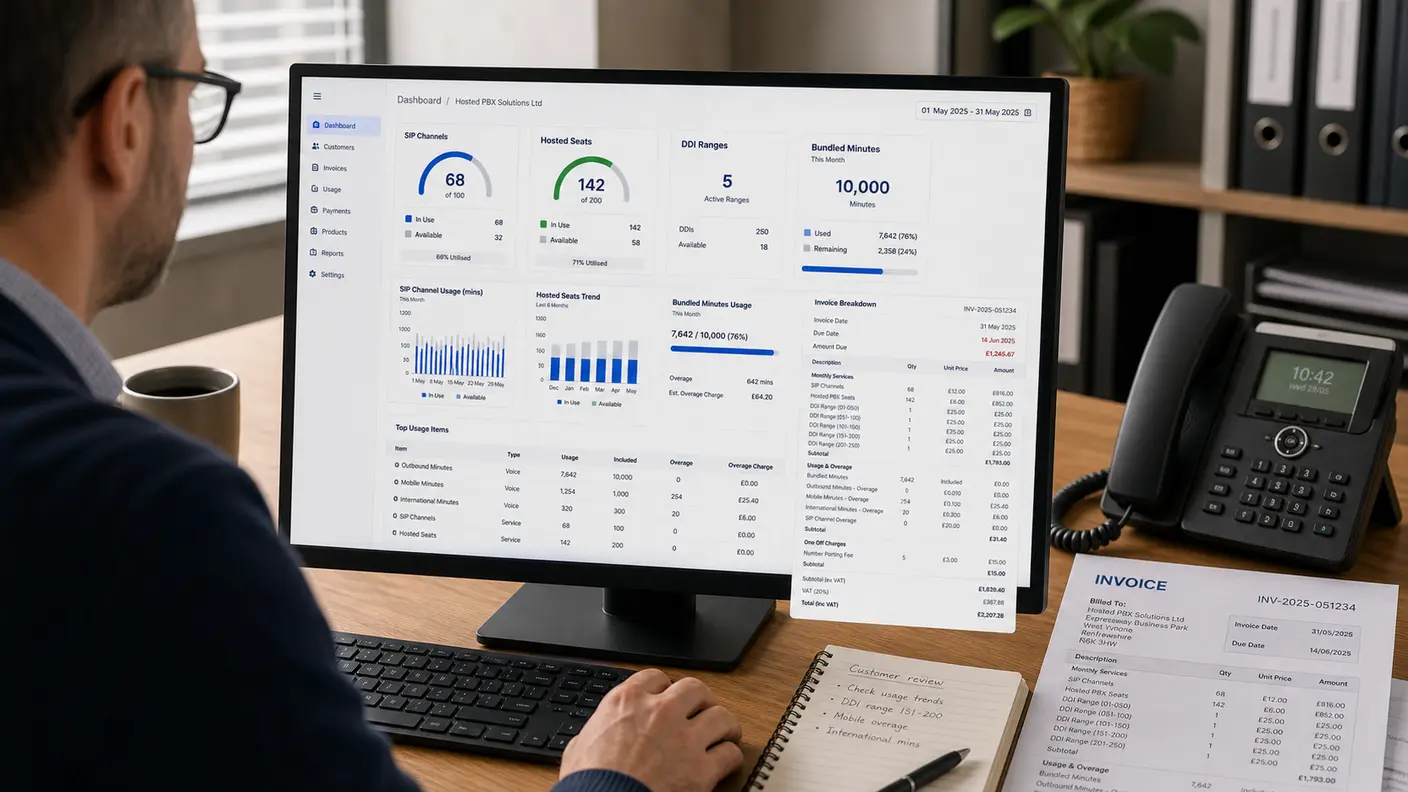
Billing for SIP Trunks and Hosted PBX: How SAFE Rates IP Services
SIP trunks and hosted PBX are the two pieces of the modern UK voice stack. After the 2027 PSTN switch-off, almost every voice line in the country will be one or the other, often both. The billing question is how to charge per channel, per seat, per minute and per number on the same invoice without making the customer reach for a calculator.
SAFE Billing Platform handles all of this in the same billing run, whether your customer base is a single one-handset sole trader or a reseller with thousands of end customers.
Key Takeaways
- SAFE rates SIP trunks per channel, with optional per-minute call charges and inclusive minute bundles
- Hosted PBX seats are billed per user, typically monthly, with feature add-ons rated individually
- DDI ranges and individual numbers are rated separately from channels and seats
- Mixed estates of legacy WLR and modern IP services run on the same invoice during the switch-off transition
- The same configuration scales from a sole trader with one handset to resellers with thousands of customers
- Bundled minutes are tracked across the period with overage rated automatically
Key terms in this article
What is a SIP trunk?
A SIP (Session Initiation Protocol) trunk is a virtual phone line that carries voice calls over an IP network. One trunk can carry many simultaneous calls, each on its own “channel”. You buy capacity in channels, not in physical lines.
What is hosted PBX?
Hosted PBX (private branch exchange) is a cloud-based phone system. Each user has a seat with their own extension, voicemail and call-routing rules. The PBX features run in the provider’s data centre, not on hardware in the customer’s office.
What is a DDI?
A DDI (Direct Dial In) is a phone number that rings a specific person or extension inside a business, without going through a switchboard. DDI ranges are blocks of consecutive numbers, usually assigned to a customer in groups of 10 or 100.
What does ARPU mean?
ARPU (average revenue per user) is monthly revenue divided by active customers. For hosted PBX, it is typically calculated per seat. It is the headline metric for measuring how much each user is worth.
The Three Rating Models You Need
Most IP voice charges fall into one of three patterns. SAFE supports all three in the same tariff structure.
Per channel. A SIP trunk has a capacity in concurrent calls. A ten-channel trunk can carry ten calls at once. Trunks are usually rented monthly at a per-channel rate, with the same number of channels every month unless the customer requests a change.
Per seat. Hosted PBX is sold per user. Each seat is a monthly charge, often tiered by feature set: basic, standard, premium. Add-ons like call recording, voicemail-to-email transcription, or video conferencing are usually rated as extras per seat.
Per number. Numbers are separate from channels and seats. A customer with a ten-channel trunk and twenty DDIs has twenty number rental charges. Some resellers bundle a base number allowance into the seat or trunk charge; SAFE supports either model.
Calls themselves are rated against your tariff in the normal way. The call tariffs and pricing guide covers the rating chain in detail.
From One Handset to Thousands of Customers
The reason the same platform handles single-handset sole traders and resellers managing thousands of accounts is that the rating engine does not change. Only the tariff configuration and the customer hierarchy scale up.
Single sole trader. One hosted PBX seat. One DDI. A 500-minute bundle. Overage at standard rates. The invoice is three line items. SAFE bills this from the same rate card as everything else.
Small business with a few users. Six seats, two SIP channels, ten DDIs, a 2,000-minute bundle pooled across the business. The platform tracks the pool, rates calls against the bundle until it is exhausted and then rates overage individually. The invoice is still readable.
Reseller with thousands of end customers. A multi-level customer hierarchy. The reseller’s own customers each have their own seats, channels and bundles. The reseller sees aggregated billing across the base. Each end customer sees a white-labelled invoice in the reseller’s branding. The customer accounts and number management guide covers the hierarchy and the billing run guide covers the run itself.
From our experience: the customer base spans the full range. We have one-person operations being billed for a single seat alongside resellers managing thousands of end-customer accounts in a hierarchy. The platform does not care which one is which. The configuration work scales linearly with the number of distinct tariff structures, not the number of customers.
Bundled Minutes and Overage
Bundled minute allowances are where most rating mistakes happen. A few patterns SAFE handles cleanly:
Per-seat bundles. Each seat includes its own minute allowance. Overage is per seat. Useful when each user has predictable call patterns but the business does not want to pool.
Pooled bundles. A single allowance shared across all seats, all channels and all numbers in the customer account. Overage is rated against the pool. The natural fit for most small businesses.
Destination-restricted bundles. UK landline and mobile minutes pooled, international minutes rated separately. Or UK and EU pooled, rest-of-world separate. SAFE supports any split.
Rollover. Unused minutes carry into the next period, up to a cap. Common in hosted PBX packages aimed at small business.
Overage rounding rules sit in the same configuration. Per-second billing, per-minute billing, or minimum call charges all work the same way.
Mixed Estates During the Switch-Off
Through 2026, a lot of reseller customer bases will be partway through migration from PSTN to IP. SAFE bills the mixed estate without forcing a flag day. Legacy WLR lines, ISDN channels, SIP trunks, hosted PBX seats and DDI ranges all appear on the same invoice with consistent line-item formatting.
When a customer migrates, the change is a tariff switch on the customer record, effective from a chosen date. The next billing run pro-rates the legacy charges, picks up the new IP charges, and shows the change cleanly on the invoice. The PSTN switch-off resellers’ guide on safeonlinebilling.com covers the wider migration context.
Number Porting and DDI Provisioning
When a customer ports numbers in, the porting fee from the original provider is usually a one-off charge. SAFE handles this as a non-recurring item against the customer account. If the porting fee is one you pay your wholesaler and pass on to your customer, the rate card carries both sides. For the related scenario when a customer leaves you and a port-out charge arrives weeks later, the porting fees pass-through post on safeonlinebilling.com covers the contract clause to add now.
DDI ranges can be provisioned in bulk. A customer requesting a block of 100 numbers can have the whole range assigned to their account in one operation, with number rental charges applied either individually or as a single range charge depending on how the tariff is set up.
How This Compares to PSTN Billing
The biggest difference your customers will notice is that an IP voice invoice has more line items than a PSTN invoice. A PSTN customer had one rental line for the phone and a list of itemised calls. An IP customer has channels, seats, number rentals, bundles, and maybe an itemisation that mostly shows £0.00 against bundle allowances.
This is not a problem if the customer expects it. It is a problem if the first invoice arrives without a cover note. The PSTN switch-off resellers’ guide covers the customer-communication side in more detail.
Where to Start
If you are configuring tariffs for the first time, the billing run guide walks through the monthly cycle and the tariff and pricing guide covers the rating structure. For specific configuration questions, the SAFE documentation site has the detail.
If you would like a walk-through with your own rate card and a sample customer mix, the contact form is the way in.
Dr Paul Barrass
Founder & Technical Director, Safe Online Billing
Paul founded Safe Online Billing in 2005 and has built telecoms billing software for UK resellers for over 20 years. About the team →